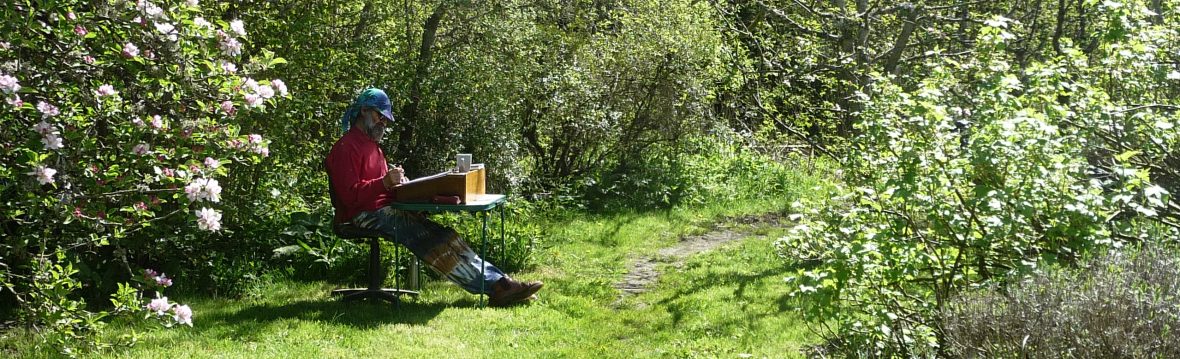

I recently had the opportunity to interview Mandy Haggith. Wikipedia says, ‘Mandy Haggith is an author, poet, and environmental activist.’ Mandy says, ‘I am a writer based in Assynt, in the north-west highlands of Scotland. My work includes poetry, fiction and non-fiction. My writing is mostly concerned with trees, bears and the sea, and I like time-travelling through fiction.’
I will list her works at the end of the interview.
Geoff: You’re latest book, The Lost Elms, was recently published; what can you tell us about it?
Mandy: It’s a ‘love-letter’ to elms around the world. I grew up with elm trees, which, when I was a child, died of Dutch elm disease as have hundreds of millions of elms around the world. This made a big impression on me and so the book is partly memoir and a mix of science, folklore and literature about elms.
G: As a poet and novelist, what motivated you to write another non-fiction book seventeen years after the first one, and with so many things impacting on the natural world, why focus on elm trees?
M: The genre or form I use always depends on what the subject matter needs – sometimes I write a poem in wonder, sometimes a thought experiment requires a novel and elms needed a non-fiction book. Why now? I have lived most of my adult life in the Highlands of Scotland, in a climate too cool for the beetles that spread Dutch elm disease, but climate change is shifting the line north and west, so my local elms are now threatened. Elms are a canary in the climate change mine. Climate change is a ‘hyperobject’, too complex to deal with in its entirety but focusing on a single species brings a lot of things into focus and clarity for me.
G: The cover of The Lost Elms is fantastic—how much input did you have in the design?
M: Lots. I have been really impressed by how my publisher Wildfire has encouraged me to participate in the cover design process. They had an initial concept and then I was able to make requests and suggestions (e.g. about specific birds and other species to be represented on it) before the final design. They even moved one of the text boxes when I complained that it was hiding the owl!
G: Has The Lost Elms been well received? You say in the book that if it ‘sells well’ you’ll be acquiring a Stubbs elm wheelbarrow (still made according to a 130-year-old design). Will you be getting a new wheelbarrow?
M: I don’t know yet. As an author there is a long wait for sales and royalty figures – and bookshops can order and then return unsold books, so orders are no guarantee of sales. But the publishers have reprinted the hardback already, so that’s a good sign!
G: It is obvious from this book and your novels that you do extensive research; how does the research process differ between fiction and non-fiction?
M: With fiction, I am intuitive in what research leads I follow and once I am immersed in research I begin writing the story, making things up, and then I fact-check madly afterwards and change everything I’ve got wrong. But for non-fiction I need to be much more systematic and I’ve had a much bigger research agenda to follow prior to writing.
G: How long have you been writing, and what prompted you to start?
M: I had my first poem published when I was eight years old, so I’ve been at it a long time. An English teacher at my school as a teenager was hurtful about one of my poems so I didn’t show anyone anything I’d written until my early 30s. I got seriously into writing then and I’m prompted mostly by wonder at the natural world and wanting to share that with other people
.
G: Which other writers inspired or influenced you?
M: Too many to name! I read voraciously. I guess if forced to name particular names I’d say for poetry, Mary Oliver, for novels, Herman Hesse, and for non-fiction Barry Lopez.
G: To what extent does your environment shape your writing? Can you write anywhere? Do you need a special pen?
M: I write poetry and fiction long-hand with pencil or fountain pen. I love lovely notebooks (narrow lines, preferably, or plain) but also write on rubbishy scrap paper a lot as that takes the pressure off drafting and playing around. I need it to be quiet – I can’t do the cafe thing, though buses and trains are usually OK. Best of all is writing on the boat, or in bed.
G: As a keen sailor, does sailing or being at sea inform your writing?
M: Yes, hugely. Several of my novels have been written entirely at sea and my latest book of poems, Briny, is all sea poetry.
G: What do you read for pleasure?
M: I read poetry first thing every morning in bed with a cup of tea before I get up – it’s the best way to wake up. I always have a prose book on the go, sometimes a novel and a non-fiction book in parallel, and I’m very eclectic. I love a good historical novel, and I read a lot of literary fiction. I always have a huge stack of nature writing, sailor’s books and history books to read and philosophy seems to feature quite a lot too.
G: You have had a long and varied writing career. How much has the publishing world changed since your work was first in print?
M: Technology has changed the game a lot – eBooks are much more common now than when I first started getting published, though in many genres, people still prefer to read hard copy and it’s now essential for authors to have a social media presence. My experience is that at the same time human values like good communication, being friendly and kind, and respect for diversity, have become more important.
G: Do you attempt to get messages across to your readers? Are you trying to challenge their perspectives or beliefs?
M: I guess so – I am generally motivated by a big idea that I feel passionate about. The Last Bear, for example, is about how animal extinction is often directly connected to cultural oppression. The Stone Stories are about greed. A big idea in The Lost Elms is that we need to stop thinking short term and being in a state of constant emergency, and instead learn to think like an elm tree about slow, systemic change
G: What do you see as the role of stories in the twenty-first century?
M: They are our cultural life blood and we need positive stories more than ever before.
G: How do you feel about the other aspects of being a writer: teaching, mentoring, book launches, readings, literary festivals?
M: I love some of that. I’ve done a lot of teaching, which I adore, though I think I probably ended up doing too much of it and I’ve now taken a step away. I love mentoring and that’s still sometime I’m very open to. I find launches and events pretty terrifying, despite doing loads over the years, although once I get started it’s fine and it’s lovely to meet people.
G: In The Lost Elms, you highlight what can be (and is being) done that offers hope for the elms’ future. Can this be expanded to a wider environmental context? Those of us who have been environmental activists for decades have seen a little progress in some areas and many frustrations in others. I interviewed several young people for my YA novel, and when I asked, ‘What is life like for teenagers in the twenty-first century?’ they all replied, ‘stressful’. What can the next generation do at a time when they are put under so much pressure? What can give them hope and inspiration?
M: Yes, it’s a hard time for young folk just now and I’ve seen how awash with negative emotions they can be. I’ve done research on this and I have evidence that being creative can help people to feel more hopeful and in particular doing imaginative exercises that involve travelling back in time and forwards in time. Plus time immersed in the more-than-human natural world is always inspiring.
G: What is your next writing project?
M: I have a novel I have been trying to write for ages about polar bears. The current working title is The Impossible Polar Bear! I hope it proves possible in the end.
Mandy Haggith works at the University of the Highlands and Islands, teaching creative writing and doing creative research.
Bibliography
Mandy Haggith is the author of five novels and six poetry collections and has contributed to the journal Reforesting Scotland.
Novels
The Last Bear (2008)
Bear Witness (2013)
The Stone Stories trilogy:
The Walrus Mutterer (2018)
The Amber Seeker (2019)
The Lyre Dancers (2020)
Poetry
Letting light in (2005)
Castings (2007)
A-B Tree (2016)
Into the forest (editor) (2013)
Non-fiction
Paper Trails (2008)
The Lost Elms (2025)
You can buy signed copies of most of these books from Mandy’s online shop, or unsigned from good bookshops. https://www.mandyhaggith.net/

 Geoff King